
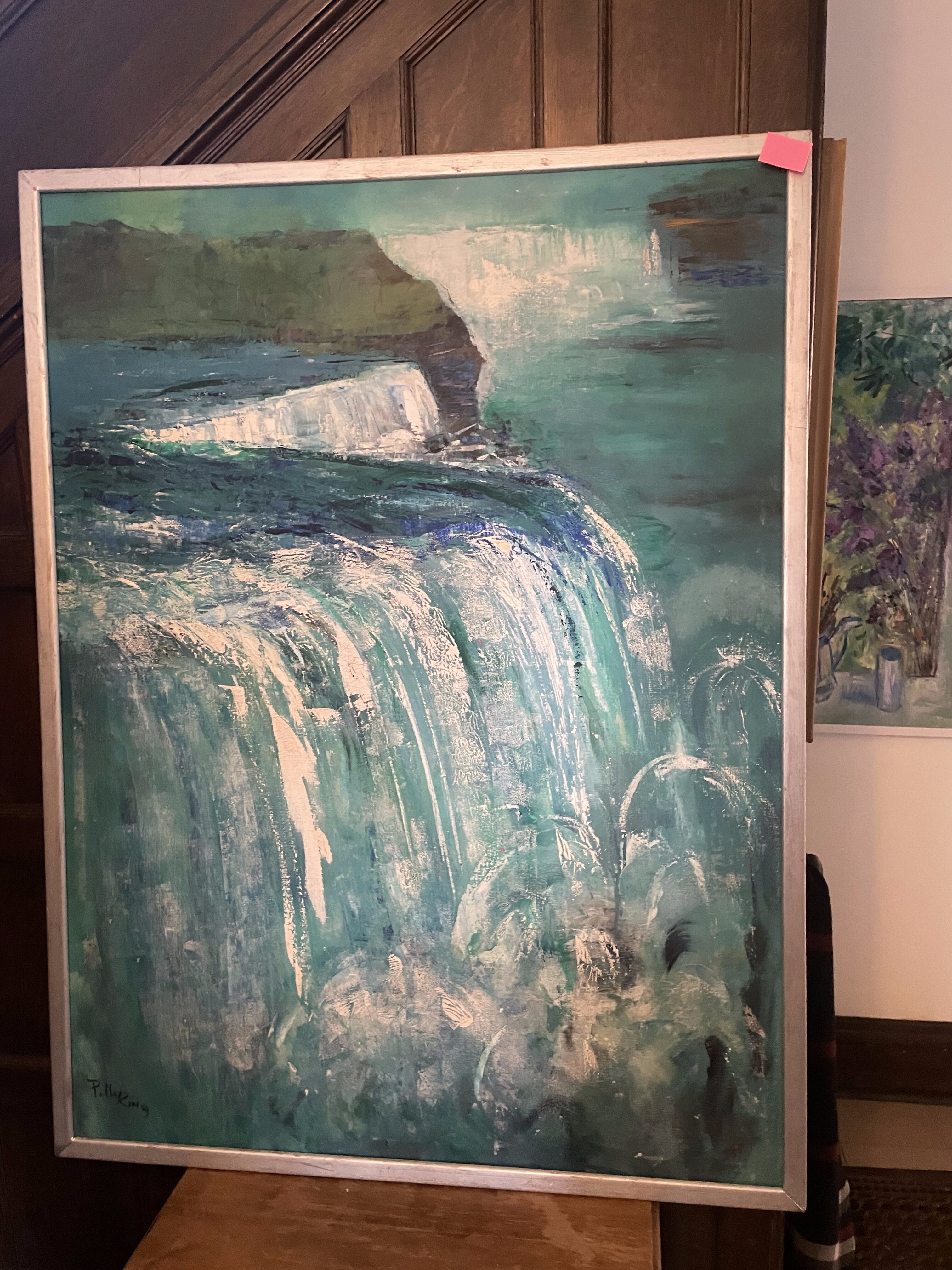
Polly King: Niagara Falls Authority On Power, Portraits, and Fantasy presents an important historical exhibition celebrating the life and work of Polly King (1901–1993), a prolific American artist whose work covers the fabric and texture of the 20th century. Born Polly Kirtz in Wheeling, West Virginia, the artist would later be known as Polly King. In the early 1920s she traveled north to visit family and, in a move considered scandalous for a young woman of her era, chose to remain in Buffalo independently. There she began to establish herself artistically, later meeting her future husband, Marvin King. Following their marriage in 1925, she relocated to Niagara Falls, New York in 1927, where her husband joined a local law firm and where King would live and work for the remainder of her life. Polly King: Niagara Falls Authority On Power, Portraits, and Fantasy is on display at the Saturn Club, at 977 Delaware Ave, Buffalo, NY 14209 from January 23 to July 1st.
As was customary at the time, her early appearances in the press did not identify her by her given name; instead, she was referred to as Mrs. Marvin King. Throughout her career, she experimented with a range of artistic identities, exhibiting under names including Pique’ in the 1920s, PKK and Paulin King following her marriage, before ultimately settling on Polly King. She painted continuously for more than seven decades, producing an expansive and deeply personal body of work. Her art captured the people, power, and imaginative force of Niagara Falls while also reflecting a broader, international engagement with place and material as an avid traveler, even incorporating dust from Spain in her paints. As King herself observed, “art is universal.” She remained active as an artist until her death at the age of ninety-three, leaving behind a legacy defined by persistence, curiosity, and a lifelong commitment to making.
Her practice developed fluidly between impressionism, realism, portraiture, and abstraction. In an era when women didn’t graduate, but merely attended for a while, King studied painting at Carnegie Institute, Pittsburgh, Pennsylvania; Art Students League of New York, Cooper Union, andthe National Academy of Design, in New York City; University of Buffalo and the Albright Art School in Buffalo, New York, and training under influential teachers such as Charles Hawthorne, Ivan Olinsky and George Bridgman. While grounded in academic traditions, her work evolved toward increasingly vibrant and open compositions marked by bold color, dynamic brushwork, and intentional incompleteness. “I don’t like anything that’s finished,” she said. “I like it to stay alive.”
This exhibition is organized around the core themes of Power & Construction, Portraits, Fantasy & Abstraction. At the center of the exhibition are King’s extraordinary paintings of the large-scale industrial development in Niagara Falls, including the Power Project Conduit that cut through and reshaped the region. King recalled that no one ever seemed to mind as she painted on location at active construction sites, translating the scale,effort, and exhilaration of modern industry into abstract compositions that pulse with energy. These works reframe industry not as static or oppressive, but as animated, human, and deeply American. King’s extensive portrait practice reflects the rich social and cultural history of Niagara Falls and the surrounding region. Her sitters include individuals who lived in the city, visited it, or crossed paths with her, forming an intimate visual archive of a community shaped by labor, tourism, industry, and movement. Interwoven throughout her practice are moments of fantasy—dancing apparitions that rise up through the infrastructure, neon-lit streets, wet pavement reflecting jewel-like color, and everyday objects elevated through pattern and design. For King, abstraction was an adventure of the mind rooted in observation and emotion. She believed art softened the hardships of life and trained the eye to recognize that “every day holds treasures.”
Art permeated every aspect of King’s life. She painted floors, ceilings, window panes, and furniture, transforming her home into a living artwork now preserved as the Polly King Art Gallery in Niagara Falls. Thousands of her works—along with journals, photographs, and sculptures—remain carefully preserved, offering insight into a practice driven not by wealth or recognition, but by wonder.
Through portraits, city scenes, and industrial studies, Polly King captured the evolving identity of Niagara Falls with rare intimacy and empathy. Her work is further situated within the broader cultural history of Niagara Falls with Women of Niagara, an installation of eighty-six artworks in the windows of the former Jenss Department Store building on Main Street—once a vibrant commercial and social hub and later a symbol of the city’s economic shifts. The project was sponsored by the New York State Downtown Revitalization Initiative in partnership with Niagara Falls National Heritage Area and the Polly King Gallery.
King was also a vital cultural presence beyond the studio. She organized the Niagara Falls Society of Artists to stimulate and coordinate artistic spirit in her community. Her work has been exhibited nationally and internationally at venues including the Schoneman Gallery, and Sills & Company in New York City; the Junior League of Buffalo; Burchfield Art Center, Sisti Gallery, Gallery West, Carlton House, and Cole Gallery in Buffalo, New York; La Decoradora, Alicante, Spain; Ogelby Institute, Wheeling, West Virginia; Niagara-on-the-lake Historical Society, Ontario, Canada; Niagara Falls Power Authority, and Niagara Falls Country Club, Lewiston, New York; Progressive Art Gallery (90th Birthday Celebration), Niagara Falls Public Library, and Castellani Art Museum at Niagara University, Niagara Falls, New York, and brought art into civic, medical, and public spaces such as the children’s ward at Buffalo General and St. Mary’s Hospitals, Buffalo, New York, Memorial Medical Center, Niagara Falls, New York. Her work is represented in over 250 private collections, and has been exhibited in the offices of U.S. Senator Robert F. Kennedy and Governor Mario Cuomo of New York during their time in public service.
Often described as having “the eyes of an artist and the heart of a poet,” King wrote that she hoped her work might cheer those who encounter it, allowing them to glimpse the happiness she felt in painting “the joy I had in people, in places, and in everything.” Polly King: Niagara Falls Authority On Power, Portraits, and Fantasy honors her legacy—inviting viewers to see power as beauty, labor as choreography, and color as a vital force in how we experience the world.
This exhibition is made possible by Niagara Falls National Heritage Area, Polly King Gallery, and the Don and Betty King Family. Curated by Christina Buscarino & Alexandria Ciel of the Hunt Art Gallery.